Health Assessment Guide: What to Expect
Here's everything you need to know before your Bluecrest health assessment.
We can't wait to welcome you. To help you feel confident, prepared, and to get the most out of your visit, here's your complete guide to what's in store.
Before you come: a quick checklist
A little preparation can make a real difference to how smoothly your visit goes. Plus, it makes sure you’re able to get accurate results.
- Stay well hydrated. Drink plenty of water (around 2 pints) the evening before and again on the morning of your assessment. Being well hydrated helps us obtain your blood sample more easily. Note: You won’t need to do any urine samples on the day of your assessment.
- Avoid excessive alcohol the day before your assessment. On the day of your assessment we recommend avoiding any alcohol.
- Stop vitamins and supplements, including over-the-counter supplements, at least 3 days before your assessment for the most accurate blood results. We recommend stopping any biotin supplements at least 5 days before your assessment. You can continue taking prescription medication as usual.
- Keep taking any prescribed medication as normal. If you're taking antibiotics for an infection, we advise you to reschedule your assessment, as they can affect your results.
- If you have any additional requirements, for example reduced mobility, or anything else that might affect a test, let our Customer Success team know in advance, so we can make the right arrangements for you.
If you’re unwell, please wait at least 48 hours after your symptoms clear before attending your assessment. This ensures you get accurate results and helps to keep everyone safe. If you’re unsure, please contact our Customer Success team to discuss whether your appointment can go ahead as usual.
Please check our exclusions before attending your appointment, as things like vaccinations, pregnancy, and age can all affect our assessments. This list is not exhaustive, and if you have any specific concerns, please contact our Customer Success team.
Arriving at your assessment
Please arrive promptly, 10 minutes before your scheduled appointment time. Once you're here, reception will point you towards the waiting room, and your Health Assessment Specialist will come to collect you when it's time to begin.
There’s no need to check in at the assessment room or knock on the door – simply take a seat and relax until they come to greet you.
Very occasionally, we may need to reschedule due to unforeseen circumstances. If that happens, we'll be in touch as soon as we can to arrange a new time that suits you.
Who you'll meet
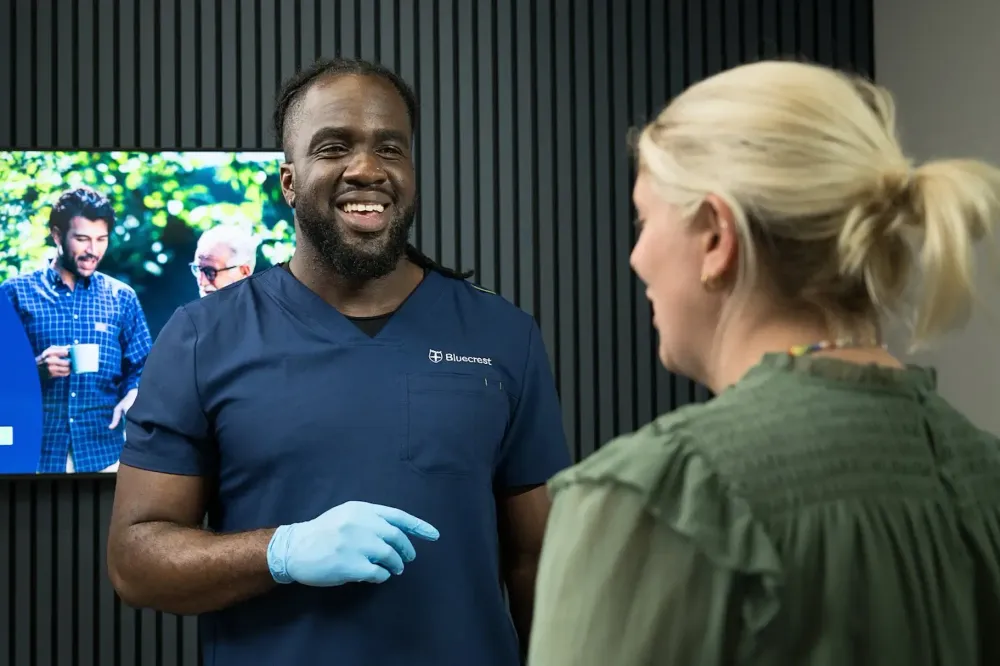
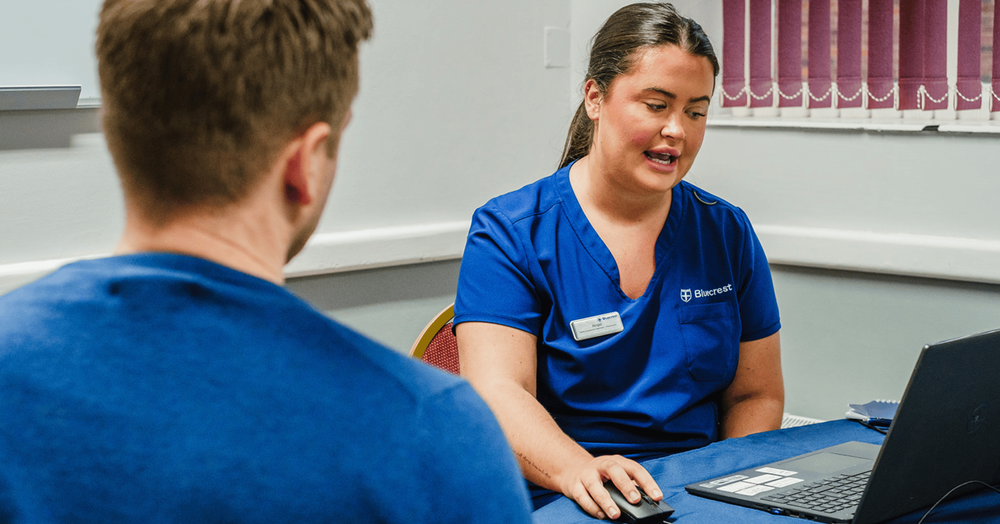
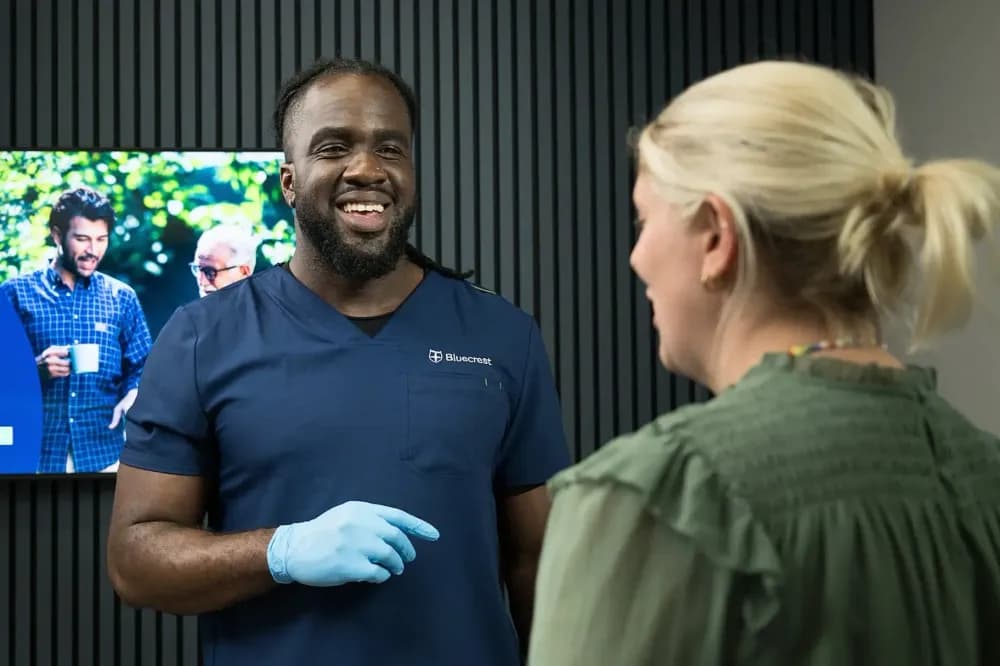
Your Health Assessment Specialist will guide you through every step of your appointment, taking key measurements and, if your package includes it, a couple of small blood samples.
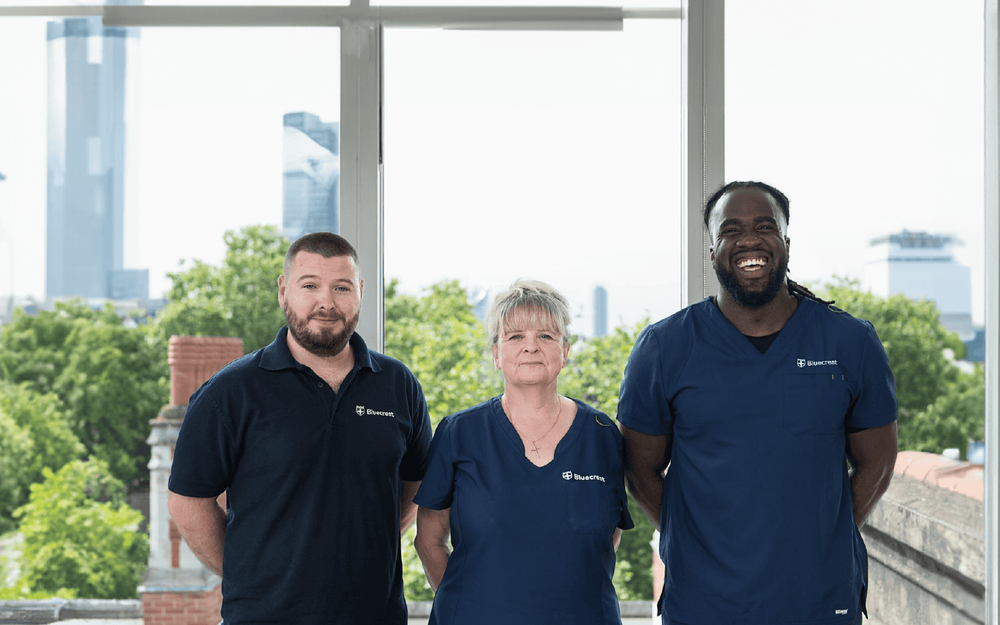
Although our Health Assessment Specialists aren't doctors or nurses, they're fully trained phlebotomists and meet all the required standards to carry out your assessment safely and accurately. They're warm, professional, and will work with you to make sure you're comfortable.
For any health concerns, your GP or pharmacist is your go-to.
What to wear
You won't need to undress. Wear loose, non-restrictive clothing with sleeves and trouser legs you can roll up easily. We'll need access to your bare arms and bare lower legs, so please avoid tights.
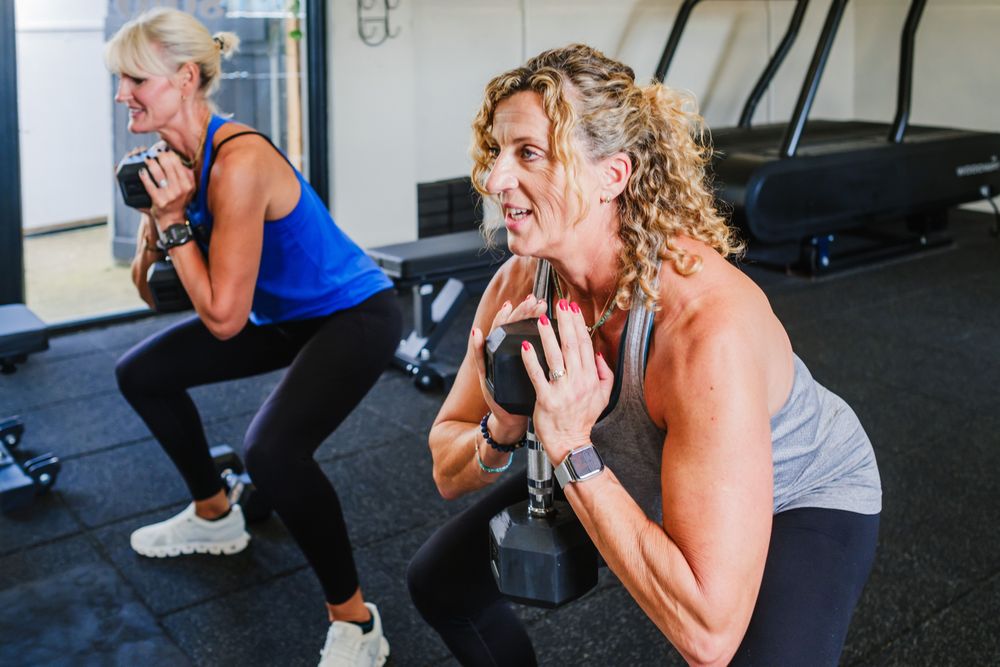
For footwear, wear flat, supportive shoes such as trainers. Some assessments involve a fitness test, which you won't be able to complete in inappropriate footwear.
Top tips for the best, most accurate results
- Hydrate well. Around 2 pints of water the evening before and on the morning of your assessment makes a real difference to your blood draw.
- Wear flat, supportive shoes such as trainers. You won't be able to do the step fitness test in inappropriate footwear.
- Speak up. Tell your specialist about any painful limbs, varicose veins, or anything else that may affect the tests. They'll adapt where they can.
- No samples are needed on the day. There's no urine, stool, or HPV sample to produce at your appointment – these kits are given to you to complete at home, in your own time. Staying hydrated is to help your blood draw, not for a sample on the day.
What happens at a health assessment?
We carry out several tests across all our packages, and your Health Assessment Specialist will also discuss any personalisation options with you on the day, so your assessment can be tailored to you.
Click here to find the tests we offer, where you can read more about each one. Exclusions apply to some tests, please see here for more information.
Here are some of the things we may assess, depending on your chosen package.
Height
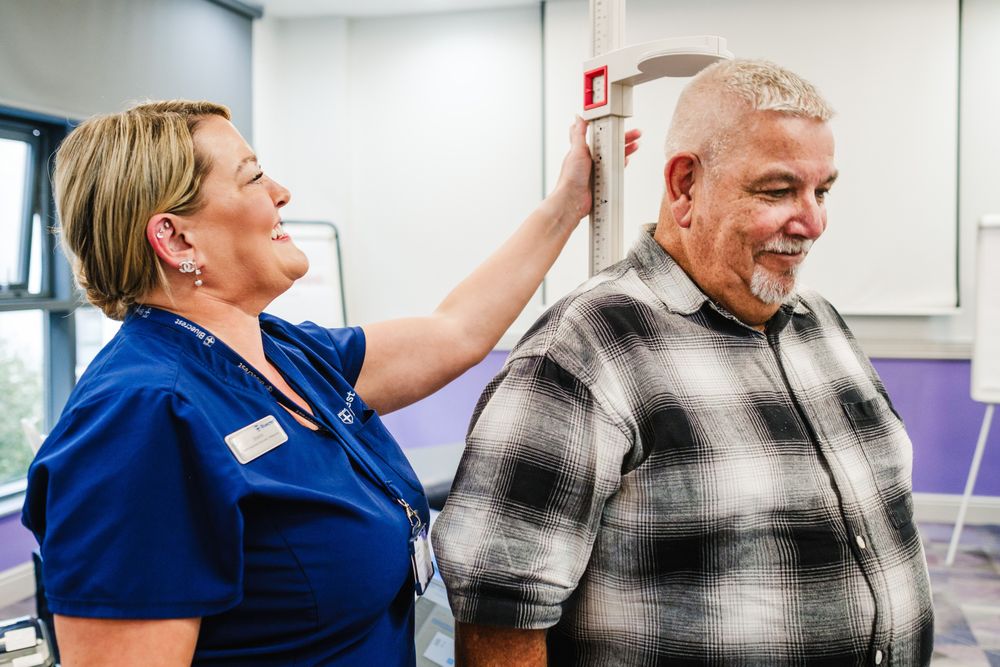
We'll measure your height using a stadiometer – a precise standing height gauge. We'll ask you to remove your shoes for an accurate reading, then stand on the base plate with your back against the measure.
Body composition (via biometric analysis)
This test goes well beyond just weight – it analyses 13 measurements including muscle mass, visceral fat, and total body water. You'll stand barefoot on smart scales while foot sensor pads send a low, safe electrical signal through your body. Results are uploaded to our software for full analysis.
This test requires you to weight-bear on both legs. Please let your specialist know in advance if this could be an issue.
Your heart (via a 6-lead electrocardiogram or ECG)
An ECG gives us a detailed picture of your heart's electrical activity, including rate and rhythm. You'll lie on a bed while small stickers are placed on your wrists and lower legs – then simply stay still while the machine records the traces. All results are sent to our specialist laboratory for analysis and reporting.
Your arteries
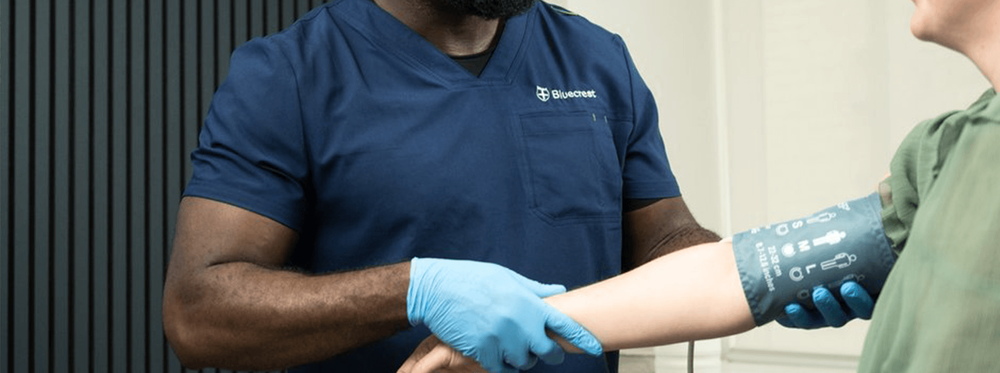
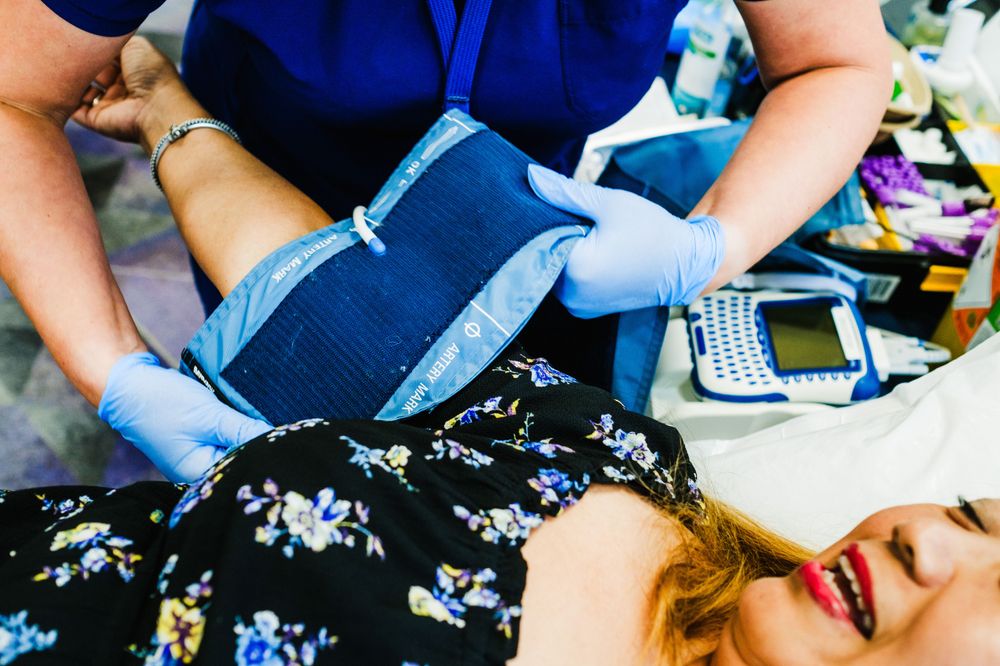
This test detects the build-up of fatty deposits in your arteries – an early indicator of cardiovascular risk. It's offered to customers aged 40–79, as results outside this age range can be unreliable. You'll lie on a bed while blood pressure cuffs are placed on your lower leg and upper arm. The cuffs inflate firmly; it can feel a little uncomfortable, but it passes quickly. You can ask your specialist to stop the PAD test at any point, no questions asked.
Your blood
A small blood sample will be taken for lab analysis. Your specialist will check both arms and select the vein that looks most accessible, using a tourniquet (a tight band) to help. They'll work as gently as possible and work with you if you feel queasy.
You may feel a sharp scratch with the needle, but it's over quickly. Afterwards, a little cotton wool and pressure keeps things tidy and reduces bruising.
Being well hydrated is the single biggest factor in a successful blood draw, so drink around 2 pints of water the evening before and again on the morning of your assessment.
Some mild bruising or tenderness at the site is completely normal for a few days afterwards. You can find our aftercare page here which has more information.
On rare occasions a blood draw is unsuccessful; if this happens, your specialist will try up to three times. You can ask them to stop at any point, and we'll arrange a reassessment.
Grip strength (hand dynamometry)
This is a quick measure of your muscle strength – you simply squeeze a handheld device as hard as you can. It takes just a few seconds and is a surprisingly powerful indicator of overall physical health.
If you have joint problems or bone and muscle pain, let your specialist know – this test can cause some discomfort.
Your lung function
You'll hold a small handheld device and blow into it as hard and fast as you can – like blowing out birthday candles with everything you've got. You'll repeat this at least three times so we capture a consistent reading.
Some people feel briefly lightheaded after this test. If that happens, stop immediately, sit down, and take a moment – it passes quickly.
Your fitness (via a step fitness test)
This is the most active part of your assessment. You'll step on and off a raised platform for three minutes while your specialist monitors your heart rate and oxygen levels using a simple clip-on finger device. Every minute, you'll be asked to rate how hard you feel you're working on a scale of 0–10.
Flat, supportive shoes such as trainers are required – you won't be able to complete this test in inappropriate footwear. Only proceed if you feel confident with your balance and coordination. If you experience any chest pain on exercise, skip this one and let your specialist know. This isn’t included in all assessments.
Take-home kits
During the health assessment you won't be required to produce any additional samples. Any urine, stool, and HPV (cervical cancer test) kits will be given to you to take away and complete at home, in your own time.
To get your full results as quickly as possible, please post your sample(s) back to us as soon as you can after completing them. Your results report can only be finalised once every sample has been received and processed, so the sooner it's on its way, the sooner you'll have your complete picture.
Your results
You’ll receive an email notification as soon as your results become available. You can view these online or via the My Wellness app.
Processing times vary by test, with some results accessible on the dashboard in as little as 3 days. Some of our more advanced tests can take several weeks to be reported.
If a critical result is identified while your results are being processed, we'll contact you straight away. Please note, a red result is not always classed as a critical result.
Your results give you a valuable snapshot of your health, but they aren't a diagnosis. Bluecrest isn't a diagnostic service, and results can sometimes differ between providers depending on the equipment and laboratories used.
If anything in your report concerns you, we recommend speaking with a GP or making use of our private GP consultation service. If you're unsure whether this service is included in your package, our Customer Success team can confirm this for you and discuss adding it to your package for an additional charge if required.
Need a helping hand?
Our Customer Success team are always happy to help. Give us a call on 0800 652 2183 to speak to one of our team.
Dr Martin Thornton
Chief Medical Officer, BluecrestAnna Jones
Chief Nursing Officer, Bluecrest