Healthy weight beyond the scales: metrics that matter
When you're looking at your weight, BMI is usually the number that gets the most attention. It's useful, but it doesn't tell you everything about how your weight is distributed or where you carry fat.
That's where other measurements, including waist-to-height ratio and body composition, can add useful context.
Your waist-to-height ratio is a simple measurement that looks at the size of your waist in relation to your height. It can help indicate whether you're carrying more fat around your middle, which is associated with an increased risk of conditions such as type 2 diabetes, high blood pressure and cardiovascular disease.
The NHS recommends keeping your waist measurement to less than half your height.
What is waist-to-height ratio?
Your waist-to-height ratio is calculated by dividing your waist measurement by your height, using the same units for both.
For example, if your waist measures 80cm and you're 170cm tall:
80 ÷ 170 = 0.47
Your waist-to-height ratio is 0.47.
The key number to remember is 0.5. A ratio below 0.5 means your waist is less than half your height. A ratio of 0.5 or above indicates increased central adiposity, meaning more fat is being carried around your middle. For adults with a BMI below 35, a ratio of 0.6 or above is classed as high central adiposity.
The NHS has a waist-to-height ratio calculator if you'd like to check yours.
How do you measure your waist?
To calculate your ratio, you'll need an accurate waist measurement.
Measure around the middle of your body, between the bottom of your ribs and the top of your hips. Keep the tape measure level and avoid pulling it tightly against your skin.
Take the measurement after breathing out naturally, rather than holding your breath or pulling your stomach in.
Why does your waist measurement matter?
BMI looks at your weight in relation to your height, but it doesn't show where that weight is carried.
Two people can have the same BMI but have very different body shapes and body compositions. One might carry more muscle, while another may carry more fat around their middle.
Fat carried around the abdomen is known as central adiposity. Some of this can include visceral fat, which is stored deeper inside the abdomen around internal organs. Higher levels of visceral fat are associated with an increased risk of conditions such as type 2 diabetes and cardiovascular disease.
This is one reason waist-to-height ratio can be useful alongside BMI rather than relying on BMI alone.
Can you have a healthy BMI but a higher waist-to-height ratio?
Yes. BMI doesn't measure body fat directly or show where you carry it. The latest Health Survey for England found that 29% of adults classed as a healthy weight by BMI had a waist-to-height ratio of 0.5 or above. Across all adults, 70% had a ratio above 0.5.
This doesn't mean BMI is useless. It means that looking at more than one measurement can give you more information.
BMI and waist-to-height ratio answer slightly different questions:
- BMI: how does your weight compare with your height?
- Waist-to-height ratio: how much fat are you carrying around your middle in relation to your height?
- Body composition: how much of your weight is made up of fat, muscle, water and other components?
What else can you measure?
Alongside BMI and waist-to-height ratio, body composition measurements can provide more detail about what your weight is made up of. Depending on the method used, these can include:
- Body fat percentage
- Visceral fat
- Muscle mass
- Body water
- Bone mass
- Basal metabolic rate
A body composition scan can therefore help you see changes that may not be obvious from your weight alone. For example, your weight may stay relatively stable while your muscle mass and body fat change.
What can affect your waist-to-height ratio?
Your waist measurement can change for many reasons, including changes in body fat, muscle mass, activity levels, diet and age.
Regular physical activity can help you maintain a healthy weight and reduce excess body fat. A combination of aerobic activity and strength training can also help maintain muscle as you get older.
Your diet matters too. Eating a balanced diet and limiting foods and drinks that are high in sugar, saturated fat and calories can help you maintain a healthy weight.
Sleep and stress can also influence your eating habits, activity levels and weight, so looking after these areas can form part of a healthy lifestyle.
What if your waist-to-height ratio is above 0.5?
A result above 0.5 doesn't tell you that you have a health condition. It's a measurement that can help indicate whether you may be carrying more fat around your middle and whether it could be useful to look at your health in more detail.
If your waist measurement is more than half your height, you can focus on the same things that support a healthy weight more generally: regular physical activity, a balanced diet, enough sleep and avoiding excessive alcohol.
It's also worth looking at the trend over time rather than focusing on one measurement. Changes in your waist size, weight and body composition can provide useful information about how your health and fitness are changing.
If you're concerned about your weight or waist measurement, speak to your GP or another healthcare professional.
How can Bluecrest help you look beyond the scales?
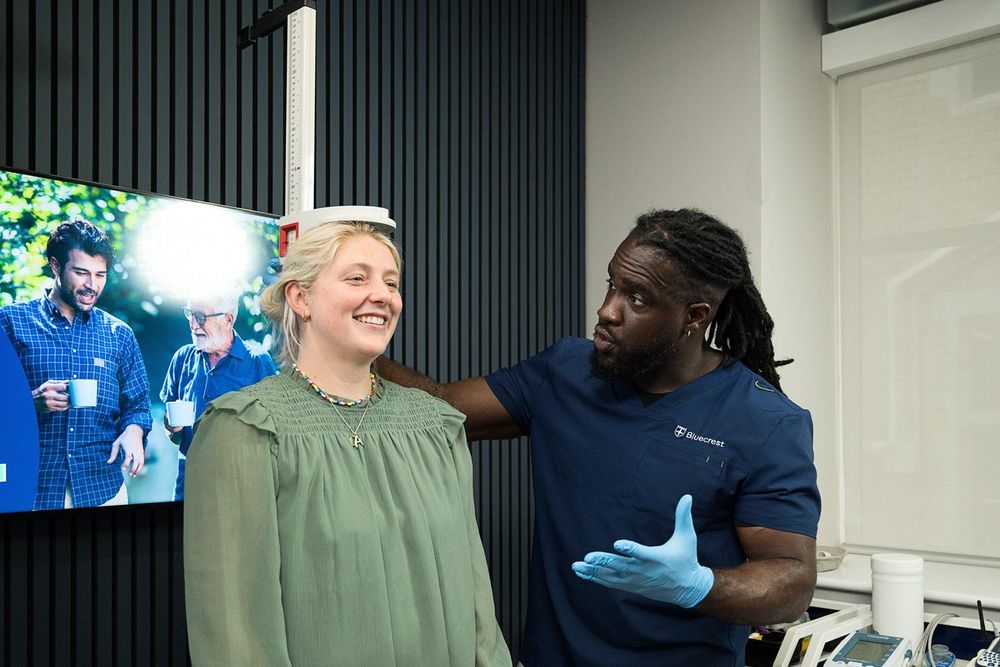
A Bluecrest Health Check can give you more information than your weight or BMI alone.
Depending on the package you choose, a body composition scan can measure body fat percentage, visceral fat, muscle mass, body water and other measures. It can help you see how your body composition changes over time, alongside other health measurements.
Your results are presented in a personalised Results Report, with clear explanations and colour-coded flags to help you understand which results are within the expected range and where you may want to take further action.
Explore Bluecrest Health Checks.
Need help? Call free on 0800 652 2183 to speak to one of our team.
This article is for general health information purposes and does not constitute medical advice. If you have concerns about your weight, waist measurement or health assessment results, speak to a healthcare professional.

Dr Martin Thornton
Chief Medical Officer, Bluecrest
Graham Jones
Medical Writer